Predict Knee Osteoarthritis from X-rays
Train a deep-learning model to grade knee osteoarthritis on X-rays, then show clinicians why it made each call.
- Length
- 8 or 14 weeks
- Mentoring
- Weekly 1:1
- Between sessions
- Q&A channel
- Price
- From $1,900
What you will do
The project
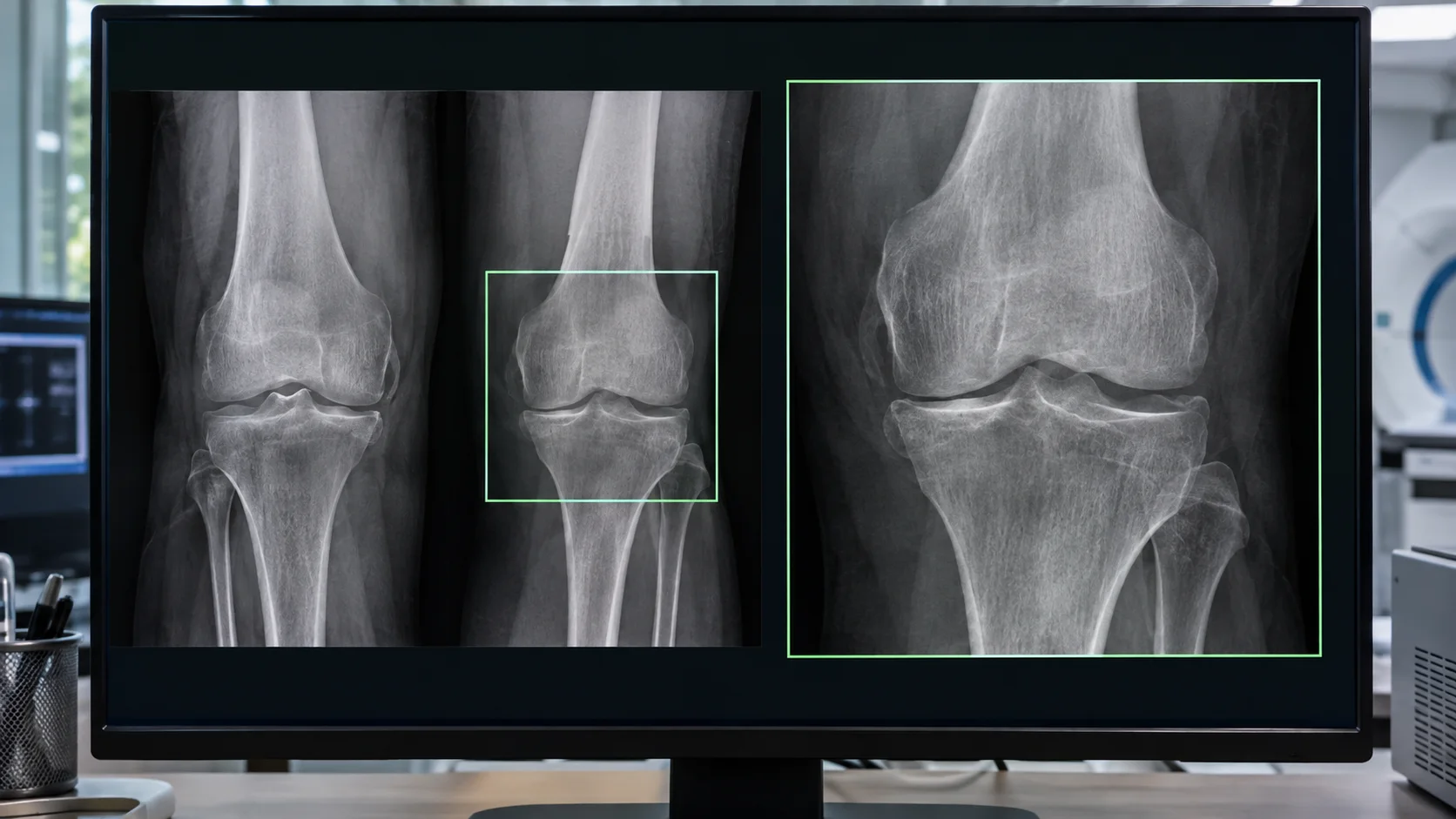
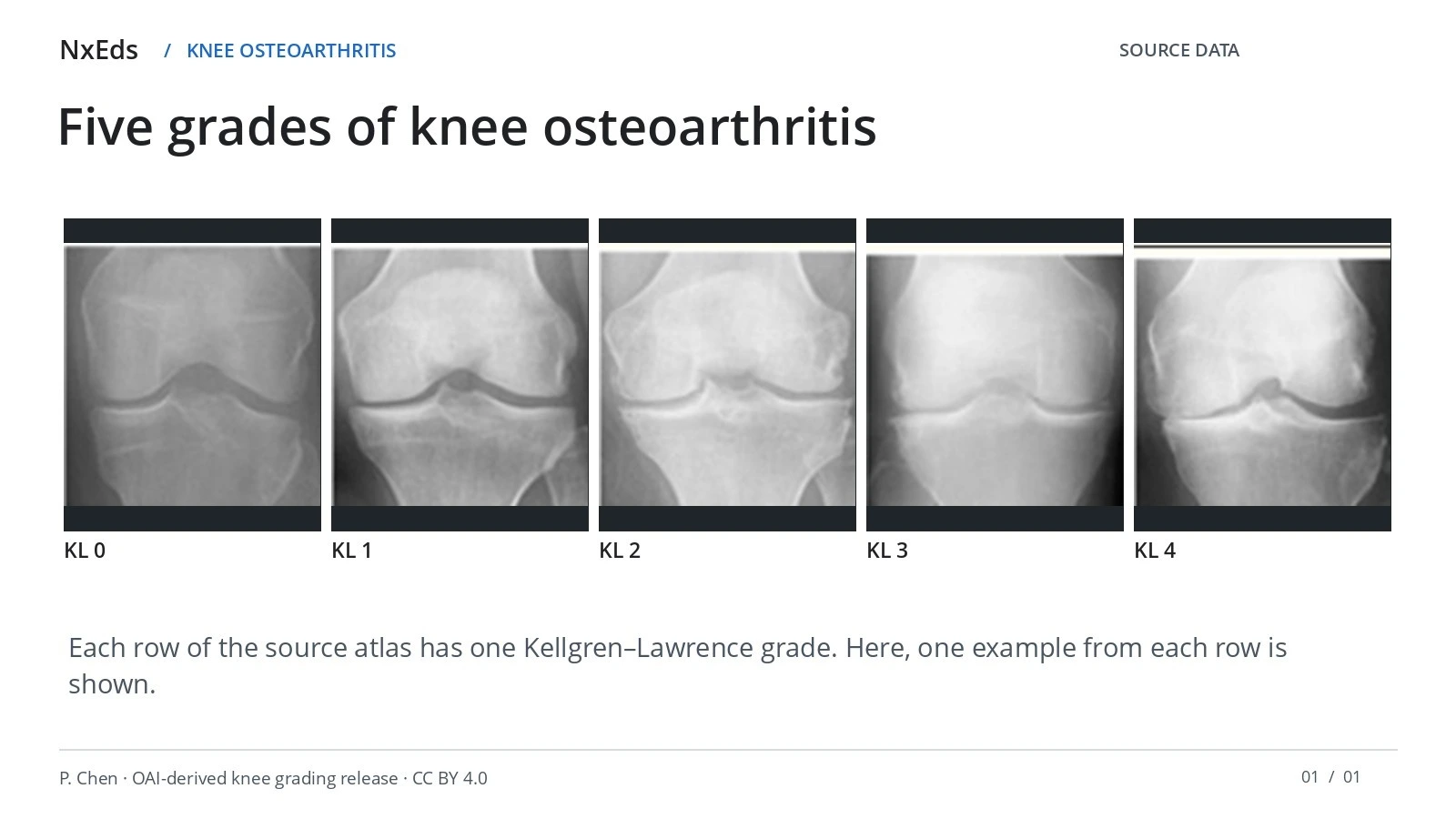
Osteoarthritis is one of the most common causes of joint pain and disability. Radiologists grade its severity on X-rays with the Kellgren–Lawrence scale, and grades can vary from one reader to the next.
In this project you build a model that grades severity automatically and explains its reasoning. It is the same kind of problem Dr. Harari's group studies in its osteoarthritis research.
What you will build
- A cleaned, patient-level split knee X-ray dataset
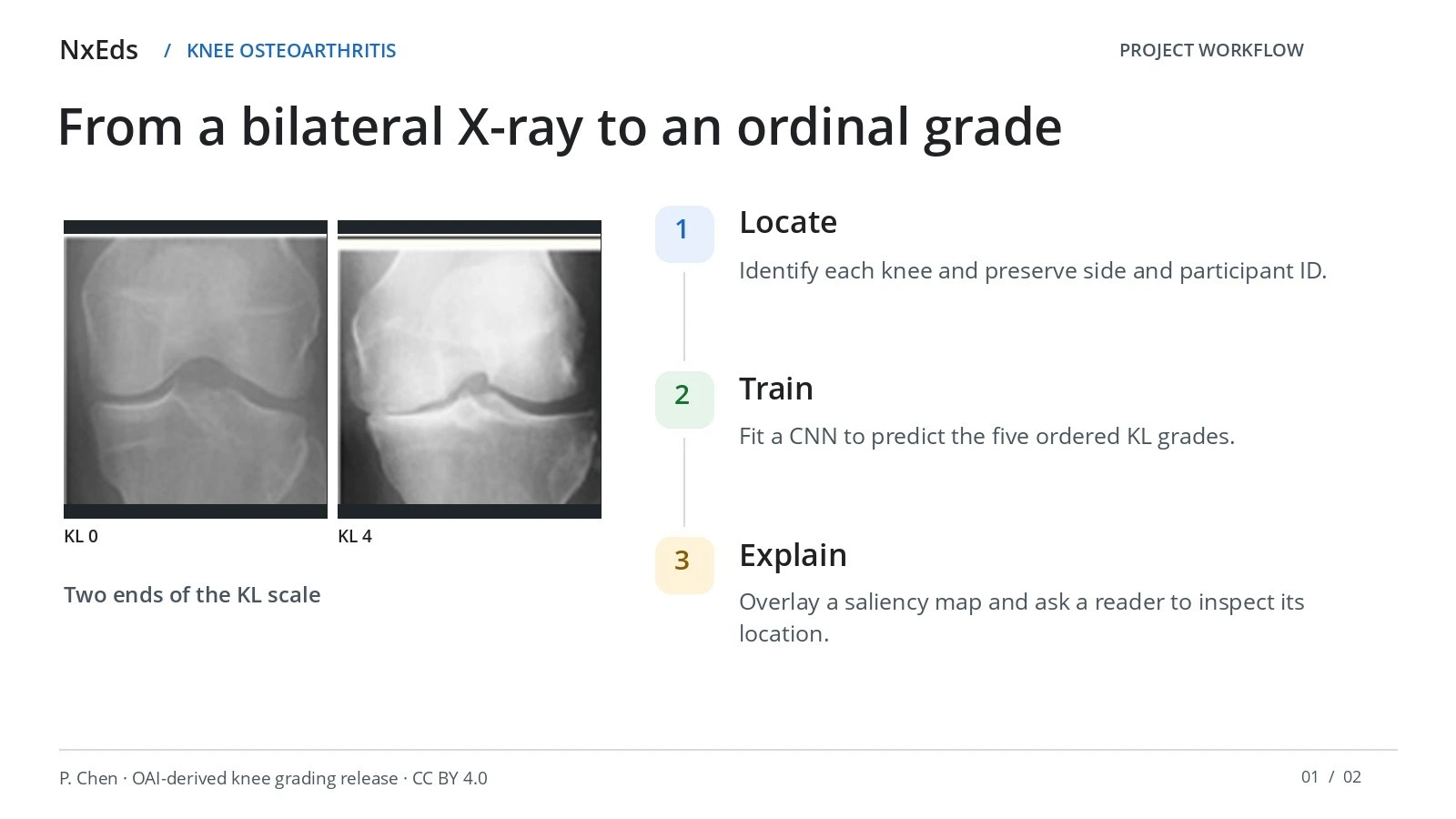
- A convolutional neural network that predicts the Kellgren–Lawrence grade
- Heatmaps that show which parts of the joint drove each prediction
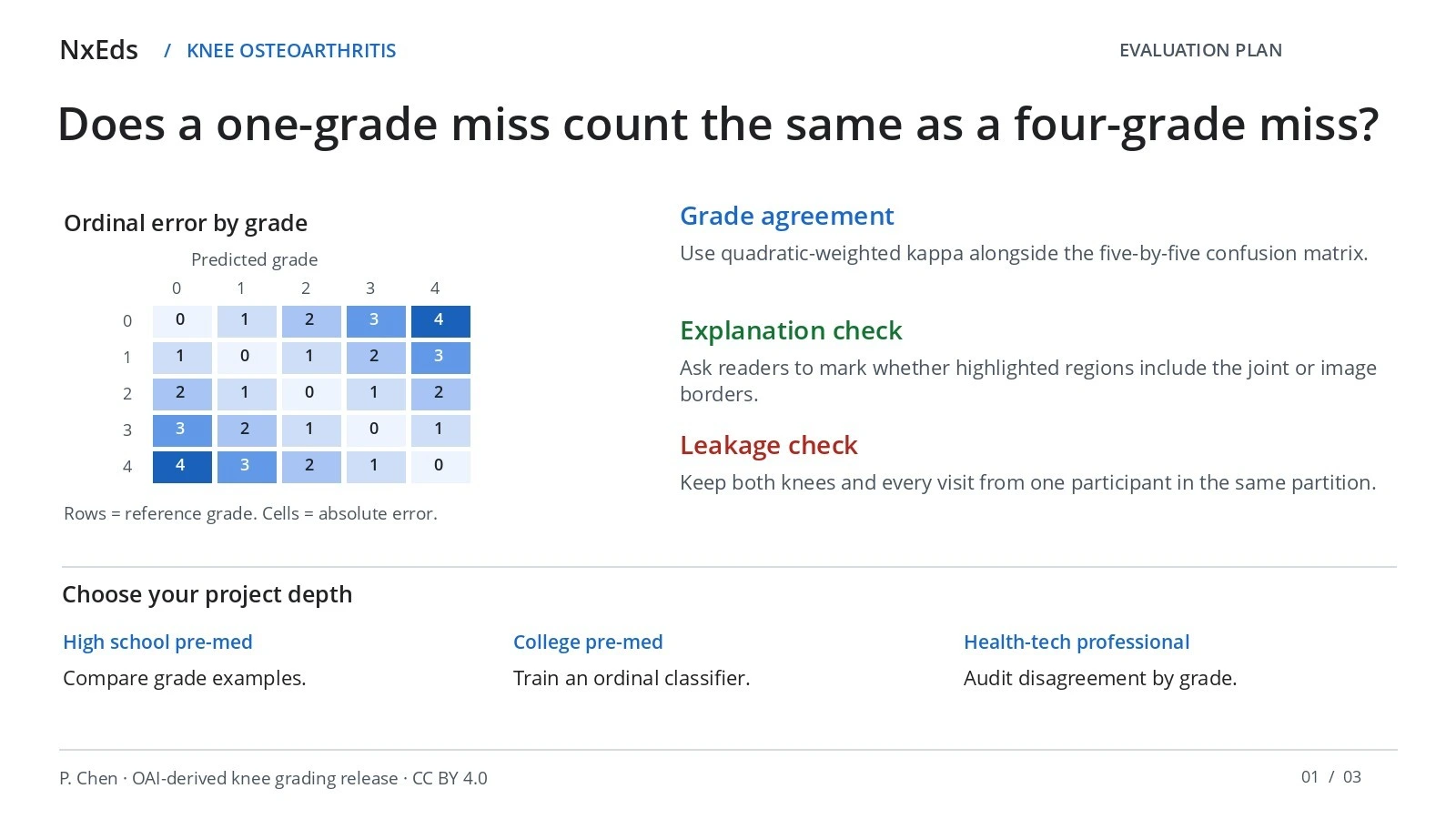
- An evaluation report with accuracy, a confusion matrix and failure cases
The clinical problem
See what you will be working on
Your journey
From week 0 to your final presentation
Here is where you start, and what you will be able to do by the end.
Week 0: where you start
- No AI or coding experience needed. Your mentor teaches what you need, at your level.
- A laptop and a free Google account. We work in free, browser-based notebooks.
- Curiosity about a medical question, and 3–6 hours a week.
Final week: where you finish
- Explain how osteoarthritis is graded and why grading varies
- Prepare medical images for deep learning without data leakage
- Train and tune an image classifier with transfer learning
- Show and critique what the model looks at with heatmaps
- Present results like a researcher, including limitations
Curriculum
Your project, step by step
Shown for the 14-week Publication Fellowship. The 8-week Project Fellowship covers the same steps at a faster pace and focuses on the core build.
- 1Output: Research question
Weeks 1–2
Understand the clinical problem
Knee anatomy, how osteoarthritis is graded, and a short literature review that ends in your research question.
- 2Output: Clean dataset
Weeks 3–4
Prepare the data
Load the images, crop the joint, normalize, and split by patient so results are honest.
- 3Output: Trained model
Weeks 5–8
Train your model
Transfer learning, data augmentation and tuning, with weekly code reviews.
- 4Output: Evaluation report
Weeks 9–11
Evaluate and explain
Accuracy by grade, heatmaps, and a close look at where the model fails.
- 5Output: Report and poster
Weeks 12–14
Write and present
Turn your results into a write-up and poster, then present at Demo Day.
Weeks 1–2
Understand the clinical problem
Knee anatomy, how osteoarthritis is graded, and a short literature review that ends in your research question.
What you will cover
- Knee anatomy and how osteoarthritis develops
- The Kellgren–Lawrence grading scale
- Reading 3–5 key papers and writing your question
Weeks 3–4
Prepare the data
Load the images, crop the joint, normalize, and split by patient so results are honest.
What you will cover
- Loading X-ray images in Python
- Cropping the joint and normalizing images
- Patient-level train, validation and test splits
Weeks 5–8
Train your model
Transfer learning, data augmentation and tuning, with weekly code reviews.
What you will cover
- How convolutional networks learn from images
- Transfer learning from a pretrained model
- Augmentation, tuning and tracking experiments
Weeks 9–11
Evaluate and explain
Accuracy by grade, heatmaps, and a close look at where the model fails.
What you will cover
- Accuracy, confusion matrix and per-grade errors
- Grad-CAM heatmaps and what they can and cannot show
- Comparing your model with reader variability
Weeks 12–14
Write and present
Turn your results into a write-up and poster, then present at Demo Day.
What you will cover
- Structuring a short research report
- Designing a clear poster and figures
- Demo Day talk and Q&A practice
How each week works
A typical week in your fellowship
- 1
Each week
1:1 session with your mentor
60 minutes to review progress, solve problems and plan the week.
- 2
During the week
Work through your tasks
Guided notebooks, readings and short exercises, at times that suit you.
- 3
Anytime
Ask in your channel
Questions and advice from your mentor team, answered within one business day.
- 4
End of week
Share progress, get feedback
Post your progress and get written feedback before your next session.
Skills you will gain
Tools
Data
A public knee X-ray grading release derived from the Osteoarthritis Initiative (OAI), CC BY 4.0. No real patient records are ever used.
Research questions you could explore
- Can AI predict which knees will get worse over time?
- Does adding age and BMI improve grading?
What you get
When you finish
Certificate
When you complete the project.
Letter of recommendation
If you meet all requirements.
Demo Day and project page
Present and share your work.
Publication support
For strong results, in Research and Publication Fellowships.
Pricing
Choose your fellowship length
Project Fellowship
8 weeks · A focused first project: build, evaluate and present a working medical AI model.
$1,900
One-time payment, or 3 payments on request
- 8 weekly 1:1 sessions (60 min)
- Private Q&A channel with your mentor
- Starter code, curated public data and templates
- Demo Day and a public project page
- Certificate and letter of recommendation*
Publication Fellowship
14 weeks · The full research cycle, from clinical question to poster, abstract and manuscript draft.
$2,900
One-time payment, or 3 payments on request
- 14 weekly 1:1 sessions (60 min)
- Private Q&A channel with your mentor
- Research question, analysis and poster
- Abstract, conference and manuscript support
- Certificate and letter of recommendation*
Get ready
Courses that pair well with this project
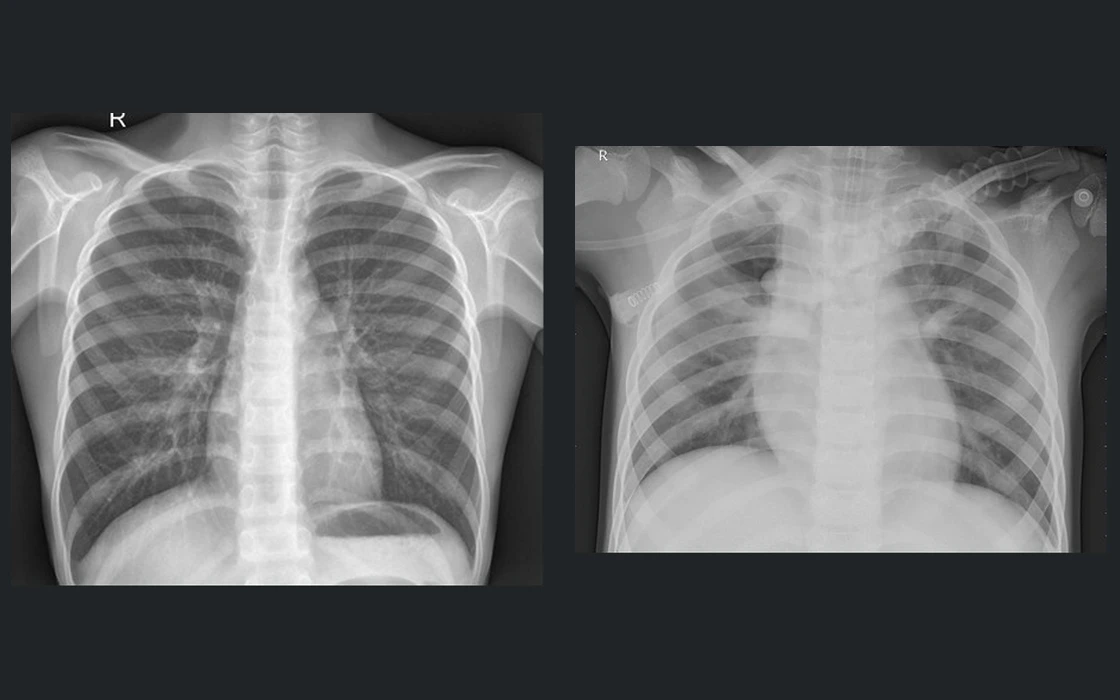
Deep Learning for Medical Imaging
Build image classifiers for X-ray, MRI and OCT with modern deep learning.
Learn more →
Explainable AI for Clinical Models
Show clinicians why a model made its prediction, and learn when explanations can mislead.
Learn more →
Python for Medical Data
Go from zero to confident with Python, using real clinical tables, images and signals.
Learn more →Questions
Is this project right for my level?
Yes. The same project runs at different depths. Your mentor adjusts the materials and goals for pre-med high school students, pre-med college students and health-tech professionals.
How much time does it take each week?
Plan for your 60-minute 1:1 session plus about 3–6 hours of independent work, depending on your fellowship length and goals.
Can I bring my own idea?
Yes. These questions are starting points. Many learners shape their own question with their mentor in week one.
Explore other projects
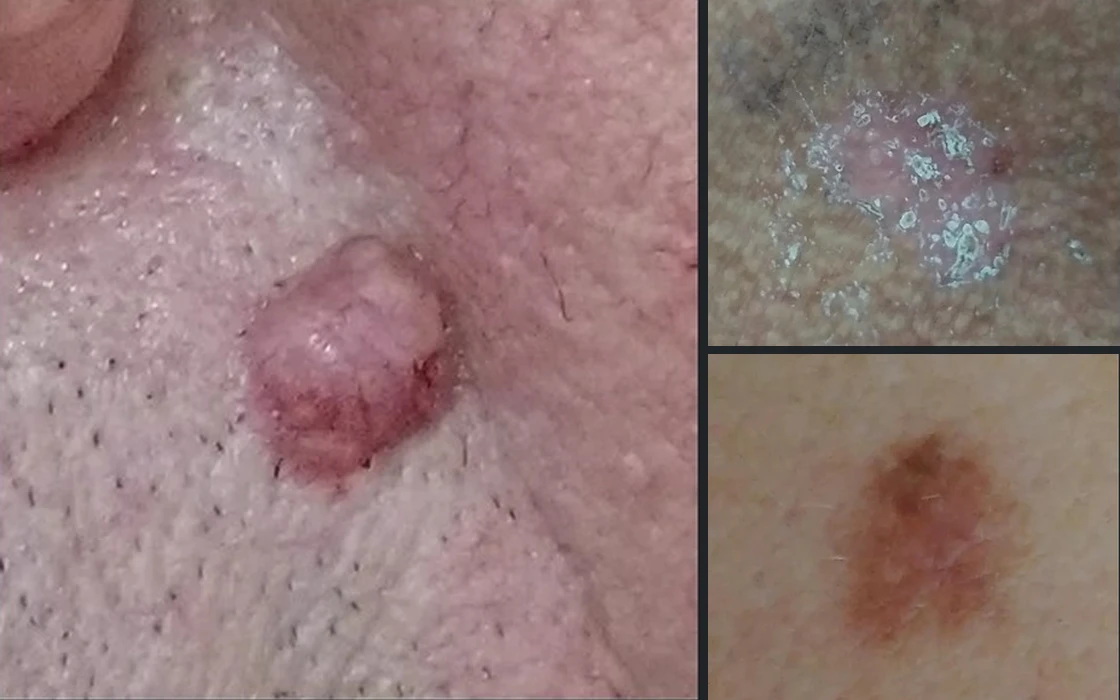
Detect Skin Cancer in Dermatology Images
Build a model that flags suspicious skin lesions for a dermatologist to review, and test whether it works fairly for everyone.
Learn more →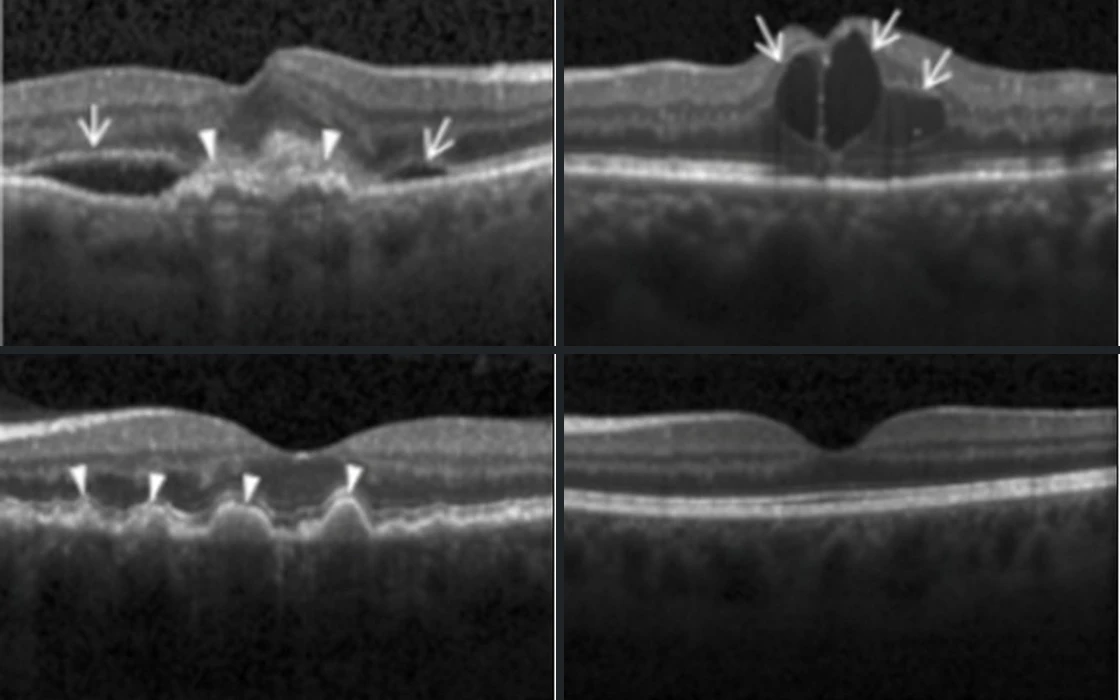
Find Eye Disease in Retinal OCT Scans
Teach a model to read retinal scans and spot conditions such as macular edema before they threaten vision.
Learn more →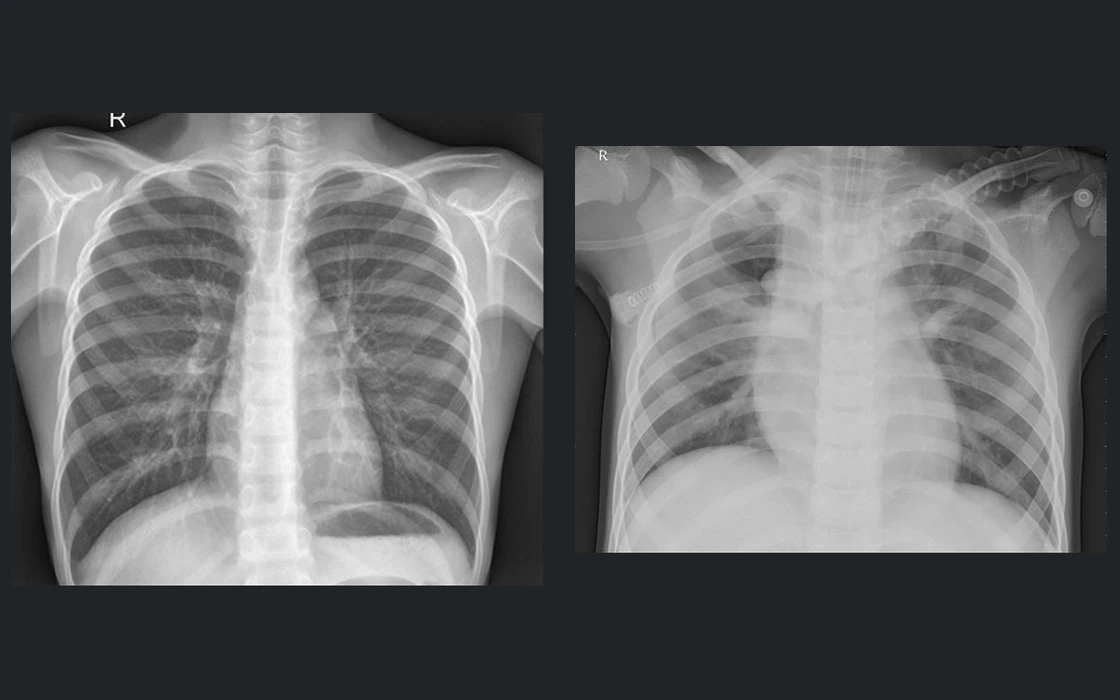
Spot Pneumonia on Chest X-rays
Build your first medical imaging model end to end, then test whether its explanations point at the right place.
Learn more →Ready to start this project?
Pay online, choose 3 payments, or ask us anything first.