Machine Learning Foundations for Healthcare
Understand how machine learning works and how to apply it to medical data without common mistakes.
- Price
- $399
- Length
- ~12 hours
- Mentoring
- 1:1 call + 24h Q&A
- Start
- Anytime
Your learning path
From where you are to where you will be
Before the course
- Basic Python (or take Python for Medical Data first).
- A laptop and a free Google account
- About 12 hours, at your own pace
After the course
- Explain how models learn from data
- Train regression, classification and tree models
- Avoid data leakage in medical datasets
- Choose metrics that matter clinically
Real data, real results
A look inside the course
Curriculum
What you will study, lesson by lesson
Day 1: your question channel opens
Ask anything about the lessons or your mini-project. A mentor answers within 24 hours, for as long as you are taking the course.
- 1
Module 1: How machine learning learns
The core ideas, without heavy math.
- What a model is
- Training versus testing
- Overfitting in plain words
- 2
Module 2: Regression and classification
Predict numbers and categories.
- Linear and logistic regression
- Predicting disease risk
- Reading coefficients
- 3
Module 3: Trees and ensembles
Random forests and gradient boosting.
- Decision trees
- Random forests
- Gradient boosting
Your 15-minute 1:1 call
Book it whenever you need it most: to get unstuck, check your progress or plan your mini-project with a mentor.
- 4
Module 4: Splits and leakage
Why patient-level splits matter.
- Patient-level splits
- Common leakage traps
- Cross-validation
- 5
Module 5: Clinical metrics
Sensitivity, specificity, ROC and calibration.
- Sensitivity and specificity
- ROC and precision-recall
- Calibration
- 6
Module 6: Mini-project
Predict disease risk from a public dataset.
- Frame a prediction task
- Train and compare models
- Report results honestly
Certificate
Awarded when you complete all modules and the mini-project.
Before you start
Basic Python (or take Python for Medical Data first). Content is suitable for pre-med students and professionals alike.
Included
Everything in this course
About 12 hours
Video lessons and readings.
Hands-on notebooks
With public, de-identified data.
15-minute 1:1 call
One-on-one with a mentor.
24-hour question channel
Ask anytime, answers within 24 hours.
Certificate
On completion.
Self-paced
Start anytime, 12 months of access.
Go further with a mentor
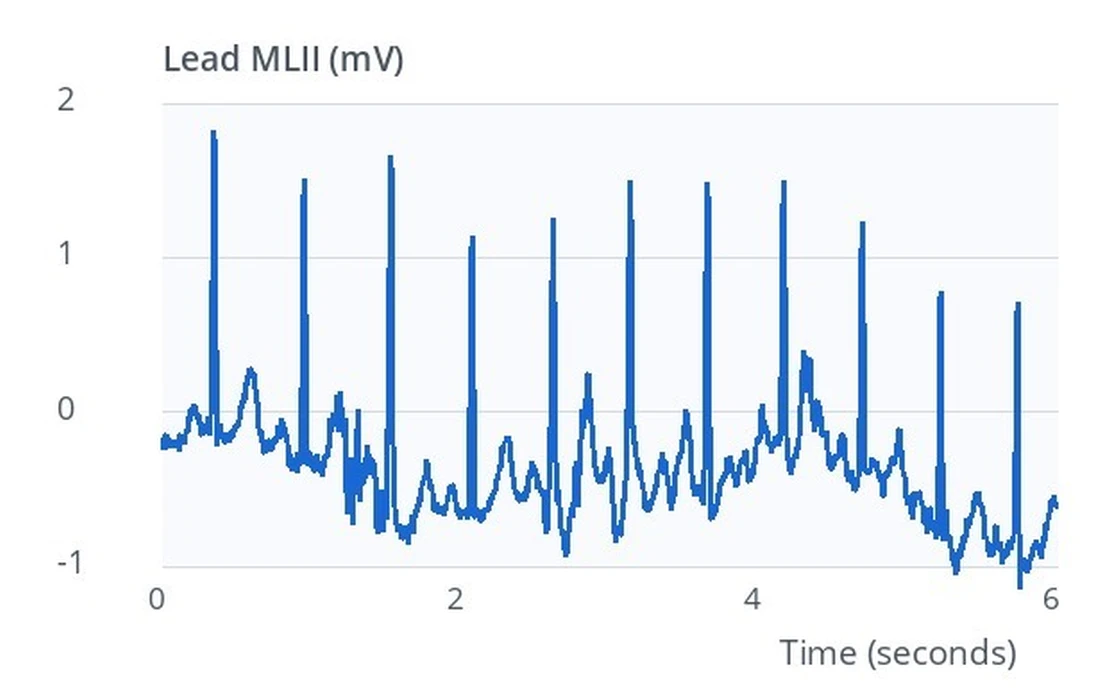
Put these skills to work: Detect Heart-Rhythm Problems in ECGs
Process raw ECG recordings and build a detector for irregular heartbeats such as atrial fibrillation.
Related courses
Python for Medical Data
Go from zero to confident with Python, using real clinical tables, images and signals.
Learn more →
Working with DICOM & Medical Imaging Data
Learn how hospital scans are stored and turn them into clean, research-ready datasets.
Learn more →
Clinical Data Science with EHR & Tabular Data
Work with electronic health record data to predict outcomes and support clinical decisions.
Learn more →Start this course today.
Self-paced, with a 1:1 mentor call, a 24-hour question channel and a certificate.